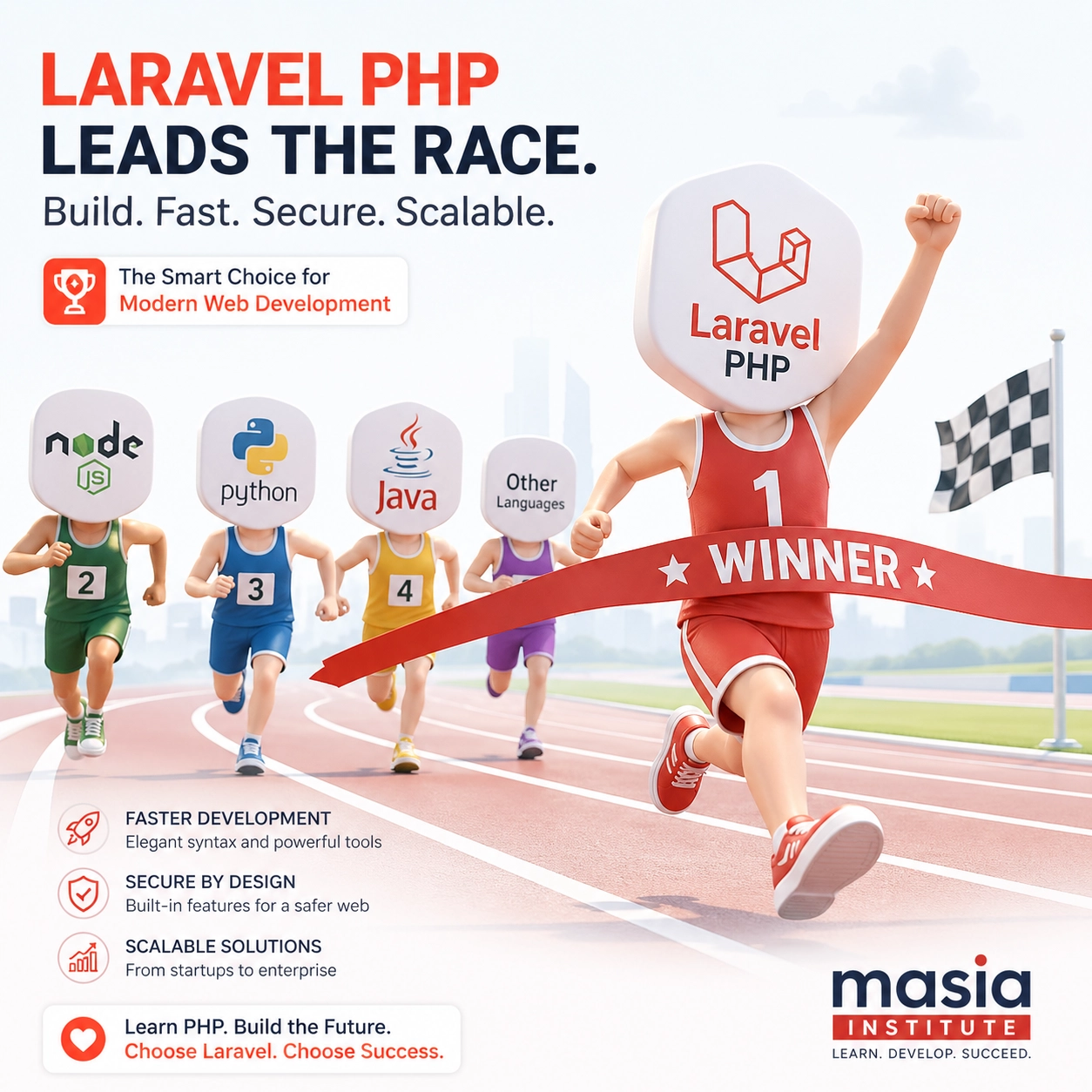
PHP vs Node.js vs Python: Which One Should You Learn?
A complete guide for beginners to choose web development platform
Wednesday, 23-Jul-2025
Ishtiaq Ahmad Khan
A complete guide for beginners to choose web development platform
One of the most common questions beginner developers ask is: "Which backend language should I learn first - PHP, Node.js, or Python?"
After training thousands of students since 2007, we at MASIA Institute have a clear answer for beginners: Start with PHP. Here is why.
"PHP is the most beginner-friendly backend language. It is easy to learn, has a huge job market, and powers over 77 percent of all websites. Start with PHP, master Laravel, and you will never run out of work."
PHP syntax is forgiving and beginner-friendly. You can start building dynamic websites within weeks.
Thousands of companies in Pakistan use PHP. Job opportunities are everywhere from small agencies to large software houses.
WordPress, Facebook, Wikipedia, and Slack all run on PHP. You will never run out of work.
PHP 8 with Laravel is as modern as any other backend technology. It is fast, secure, and scalable.
| Factor | PHP (Recommended) | Node.js | Python |
|---|---|---|---|
| Learning Curve | Easiest | Medium | Easy |
| Job Market in Pakistan | Very High | High | Medium |
| Freelancing Demand | Very High | High | Medium |
| Best For | Web Development, CMS, E-commerce | Real-time Apps, APIs | Data Science, AI, Machine Learning |
| Popular Frameworks | Laravel, Symfony, CodeIgniter | Express.js, Nest.js | Django, Flask |
Node.js (JavaScript) is great for real-time applications like chat apps and APIs. But it has a steeper learning curve for beginners because you need to understand asynchronous programming. It is a good second language after PHP.
Python is excellent for data science, artificial intelligence, and machine learning. But for pure web development, PHP is more widely used and has more job opportunities in Pakistan. Python is a great addition once you have mastered PHP.
Learn PHP first. Master Laravel. Get a job or start freelancing. Then learn Node.js or Python to expand your skills. This is the path thousands of our successful students have followed.
We have been teaching PHP since 2007 - long before it became popular in Pakistan. Our lead trainer, Sir Ishtiaq Ahmad Khan, has 18+ years of experience in PHP and Laravel development.
Our students are working in top companies, government organizations, and as successful freelancers around the world. You could be next.
Yes, absolutely. PHP powers over 77 percent of all websites. With PHP 8 and Laravel, it is more modern and powerful than ever.
With proper guidance, you can learn PHP basics in 2 months and master Laravel in 4 to 6 months.
Yes. PHP developers are in high demand in Pakistan. Thousands of companies are looking for PHP developers.
Yes, both are great additions. But master PHP first - it will make learning other languages much easier.
Join MASIA Institute's PHP and Laravel course. Learn from industry experts with 18+ years of experience.
Explore PHP CourseLimited seats available. Call us for free career counseling.